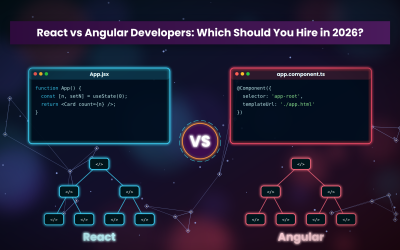
Hire React developers in 2026 if you need speed, flexibility, and the largest talent pool, especially for startups, SaaS products, and consumer apps. Hire Angular developers if you’re building a large, long-lived enterprise application where built-in structure, TypeScript-first conventions, and consistency across big teams matter more than hiring volume.
Neither option is universally better. Both ecosystems modernized significantly over the past year, and the right choice now depends less on raw performance and more on your product, your existing codebase, and how quickly you need to grow your team.
React vs Angular at a Glance:
| Factor | React | Angular |
| Type | UI library plus ecosystem | Full, opinionated framework |
| Language | JavaScript or TypeScript | TypeScript by default |
| Learning curve | Gentler start, more choices | Steeper, but consistent patterns |
| Talent pool | Very large | Smaller, more enterprise-focused |
| Best fit | Startups, SaaS, consumer apps | Enterprise and internal platforms |
| Stewardship | React Foundation |
Talent Pool and Hiring Speed:
React’s biggest hiring advantage is sheer supply. In Stack Overflow’s 2025 Developer Survey, React was used by 46.9% of professional developers, compared with 19.8% for Angular. Developer sentiment follows a similar pattern: React earned a 52.1% admiration score versus 44.7% for Angular.
Job demand mirrors that gap. An analysis of more than 3,000 frontend listings found that 68% required React. In practice, a React role typically attracts more applicants and fills faster, while senior Angular roles can take longer to close.
What Changed for Both Frameworks:
If your view of either technology is a few years old, it’s worth updating.
On the React side, React Compiler 1.0 reached a stable, production-ready release in October 2025, automatically handling memoization work that developers used to do by hand. React’s governance also shifted: React, React Native, and JSX moved from Meta to the new React Foundation under the Linux Foundation, with founding members including Amazon, Microsoft, Expo, and Vercel. For hiring managers, that signals long-term stability beyond a single corporate owner.
Angular’s changes were just as significant. Angular also keeps a predictable six-month major release cadence, which enterprise teams value for upgrade planning. The practical takeaway: Angular is no longer the “heavy legacy” choice, and React requires less manual performance tuning than it once did. What separates them in 2026 is architecture philosophy, not modernity.
Do React or Angular Developers Cost More?
Salaries are closer than most people expect. ZipRecruiter data for roles spanning Angular and React puts the US average at about $123,000 a year, with most salaries falling between $111,000 and $137,500. For contract work, one 2026 benchmark places mid-level US Angular developers at $89–$140 an hour.
The type of firm is relatively more significant than the structure itself. Compensation research across frontend postings found that employers who treat engineering as a profit center pay above market regardless of which framework they use.
The hidden cost difference is time-to-hire. Because Angular is highly opinionated, experience with it transfers less freely than React experience, which keeps the pool of senior Angular engineers tight. A slower search delays your roadmap, and that delay has a real price.
When to Hire React Developers:
React is usually the stronger choice when you are:
- Launching an MVP or scaling a startup, where speed and flexibility outweigh strict conventions.
- Building consumer-facing or SEO-sensitive products, especially with a meta-framework such as Next.js for server rendering.
- Planning a mobile app, since React Native lets web and mobile teams share skills and patterns.
- Growing a team quickly, because the larger talent pool shortens recruiting cycles.
The trade-off is decision overhead. React leaves routing, state management, and project structure up to your team, so you need senior developers who can set standards early.
When to Hire Angular Developers:
Angular tends to win when you are:
- Building complex enterprise applications such as admin dashboards, ERP-style systems, or data-heavy internal tools.
- Operating in regulated or long-horizon environments, like finance, healthcare, or government, where maintainability over many years matters.
- Coordinating large or distributed teams, since Angular’s built-in conventions reduce inconsistency between developers.
- Maintaining an existing Angular codebase, where rewriting in React rarely pays for itself.
Look for candidates with hands-on experience in signals, RxJS, and major-version upgrades, since those skills separate strong Angular engineers from developers who only know the basics.
Four Questions to Ask Before You Decide:
Before posting a role, answer these honestly:
- Do you already have a codebase? Matching your existing framework almost always beats switching.
- How big will the team get? Larger teams benefit more from Angular’s structure.
- How fast do you need to hire? Tight timelines favor React’s deeper talent pool.
- Is mobile on your roadmap? React Native gives React a clear edge.
If you’re still weighing options, our dedicated frontend developer hiring service can help you match vetted React or Angular engineers to your project. For a more comprehensive look at strategizing, there is a guide to frontend development prices.
FAQs:
Is React or Angular better for enterprise applications in 2026?
Both are used in enterprise settings. Angular’s built-in structure and TypeScript-first design make it a natural fit for large, long-lived applications, while React suits enterprises that prioritize flexibility and faster hiring.
Can we find React developers easily as compared to Angular developers?
Yes. React is used by more than twice as many professional developers as Angular, according to Stack Overflow’s 2025 survey, so React roles generally fill faster.
Do Angular developers cost more than React developers?
Average salaries are broadly similar. The bigger cost difference is hiring time, since senior Angular engineers are scarcer and searches can take longer.
Can a React developer transmute into an Angular developer?
Strong JavaScript and TypeScript developers can learn either, but Angular’s opinionated patterns take time to master. For senior roles or tight deadlines, hire for direct experience in your framework.