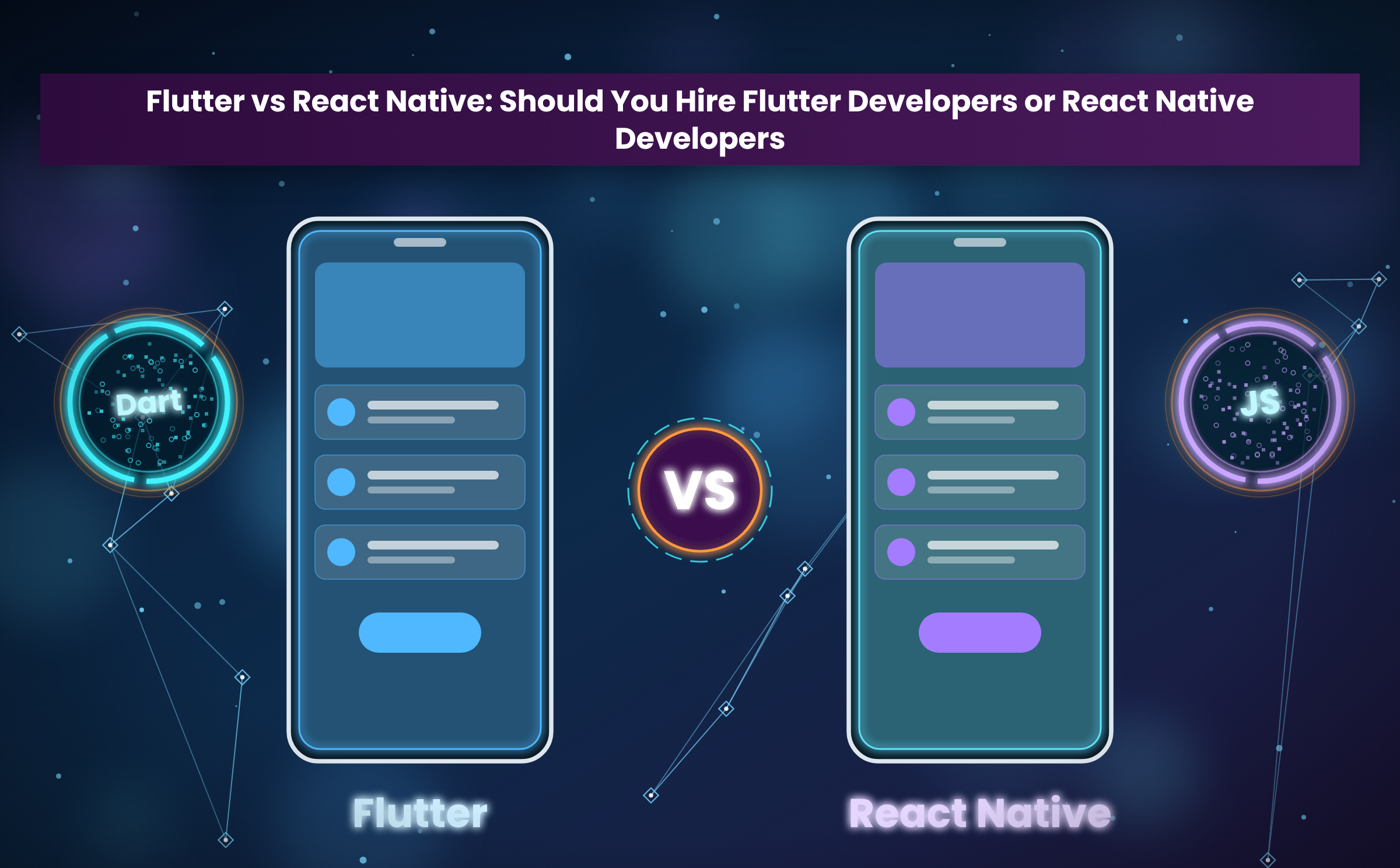


Hire React Native developers if your team already works in JavaScript or React, you need to hire quickly, or you want to share code with a web app. Hire Flutter developers if your app depends on custom, animation-heavy UI or needs to run on mobile, web, and desktop from one codebase. Both are production-ready choices in 2026.
The right choice depends less on which framework is “better” and more on your product, your existing team, and your hiring timeline. This guide compares cost, talent availability, performance, and use cases so you can make a confident decision before you hire Flutter developers or React Native developers.
Flutter vs React Native at a Glance:
| Factor | Flutter | React Native |
| Backed by | Meta | |
| Language | Dart | JavaScript / TypeScript |
| Rendering | Own engine (Impeller), draws every pixel | Native iOS/Android UI components |
| Talent pool | Smaller, growing fast | Much larger (JavaScript ecosystem) |
| Typical US senior salary | Higher (scarcity premium) | Slightly lower |
| Best for | Custom UI, multi-platform apps | JS teams, fast hiring, web code sharing |
Together, the two frameworks account for more than 80% of cross-platform app development. According to an industry analyst, React Native will have 35% of the multiplatform market; on the other hand, Flutter will have 46%.
Adoption among all developers is much closer, though: 2024 survey data shows about 9.4% of developers using Flutter compared with about 8.4% for React Native. React Native appears in around 12.6% of the top 500 US apps, versus roughly 5.2% for Flutter, which shows how established it is in large consumer products.
When should you employ a Flutter Programmer?
Instead of relying on Native features, Flutter produces its own UI.
That gives designers pixel-level control and consistent visuals across platforms. Hire Flutter developers when:
- Your UI is your competitive edge: Fintech dashboards, branded consumer apps, and animation-heavy experiences benefit from Flutter’s rendering control.
- You need more than mobile. Flutter targets iOS, Android, web, and desktop from one codebase, which is useful for internal tools and multi-device products.
- You want strong compile-time safety. Dart’s sound null safety catches many bugs before release, which can reduce long-term maintenance.
- You’re building from scratch. Without an existing JavaScript codebase, Flutter’s learning curve isn’t a disadvantage.
When to Hire React Native Developers:
React Native builds on JavaScript, the most widely used language in software development.
- If React is already used by your team: Web developers can move into mobile quickly, and business logic can often be shared between web and mobile apps.
- Hiring speed matters. The larger talent pool makes it easier to fill roles and scale a team.
- You want a native look and feel. Because React Native uses platform UI components, apps automatically follow iOS and Android design conventions.
- You rely on the npm ecosystem. Many third-party libraries, SDKs, and integrations support React Native first.
Cost Comparison: What Each Developer Costs in 2026:
Most 2026 data shows a modest price premium for Flutter talent. In the US, senior Flutter developers earn about $138,000–$180,000 a year, compared with $122,000–$160,000 for senior React Native developers, roughly a 10–15% difference driven by limited supply.
The difference is smaller offshore. Offshore React Native developers cost roughly $18–$65 per hour in 2026, with India at the low end and Poland at the high end. In India and Southeast Asia, the number of Flutter developers has grown enough that rates for both frameworks are often about the same.
Your hourly rate matters less than your total project cost. Rough 2026 estimates for a startup MVP built by two developers over three to four months come to about $40,000–$80,000 with React Native and $50,000–$100,000 with Flutter. Flutter’s faster UI development can close that gap for visually complex apps, while React Native usually costs less for teams that already know JavaScript.
Talent Availability and Time to Hire:
This is where React Native has the clearest advantage. Estimates of the job-market gap range widely, but most sources agree that React Native has several times as many US job postings as Flutter. One 2026 analysis estimates that React Native roles take three to four weeks to fill, compared with six to eight weeks for Flutter roles.
For startups that need to scale quickly or backfill developers, this difference matters. It’s also why many companies work with a staffing partner instead of recruiting for niche Flutter skills on their own. If you need pre-vetted mobile talent quickly, see our dedicated mobile app developer hiring services.
Performance in 2026: Closer Than Ever:
The old performance debate has mostly settled. Both frameworks are now mature enough for production: React Native’s New Architecture (Fabric, JSI, TurboModules) is now the default, and Flutter’s Impeller engine significantly improves rendering speed.
In practice, Flutter still has a small edge in complex animations and consistent frame rates, while React Native performs well for standard business apps. For about 90% of apps, the decision should depend on your team’s skills and product roadmap, not on benchmark scores.
A Simple Decision Checklist:
Choose Flutter if you check most of these boxes:
- Custom, brand-driven UI is a priority
- You need mobile, web, and desktop from one codebase
- You can wait a bit longer to hire, or you’re working with a partner
Choose React Native if you check most of these:
- Your team already uses JavaScript or React
- You need to hire or scale fast
- You want to share code with an existing web app
Before you commit, validate the choice with a short technical discovery phase. Our cross-platform app development guide.
FAQ:
Which is better in 2k26?
Flutter is stronger for custom UI and multi-platform reach, while React Native is stronger for hiring speed, the JavaScript ecosystem, and sharing code with web apps.
Are Flutter developers more expensive than React Native developers?
In the US, usually yes. Senior Flutter developers earn about 10–15% more because there are fewer of them. In offshore markets such as India and Southeast Asia, rates for both are often similar.
Which of the following frameworks are easier to hire for?
React Native. Its connection to JavaScript creates a much larger talent pool, and roles typically fill faster than Flutter positions.
Can we switch a React programmer to a Flutter developer?
Yes. Experienced mobile developers can usually learn Dart and Flutter in a few weeks, but for production work, it’s safer to hire someone with proven experience shipping Flutter apps.
Which framework is cheaper for an MVP?
React Native is usually cheaper if you have JavaScript developers available. Flutter can be just as cost-effective for UI-heavy MVPs because its widget system speeds up interface development.